
USAA Writes in New Jersey — Membership Is the Gate
USAA writes auto insurance in New Jersey through NAIC company code 25941, licensed and active in the state. If you're managing two or more vehicles and considering USAA, the carrier offers multi-car discounts when every vehicle sits on the same policy. The structural reality: USAA membership requires military affiliation — active duty, veteran, or eligible family member status — and without that affiliation, the household cannot open a policy regardless of how many cars you own.
This article walks through USAA's New Jersey footprint, what the membership requirement actually means for a multi-vehicle household, how the multi-car discount works when you qualify, and what to do when one household member is eligible but another is not. You'll see the specific eligibility paths, the policy-structure decision when combining vehicles, and the comparison frame when USAA is not an option.
Compare car insurance rates in your state
Get quotes from licensed carriers — no obligation, no spam, results in minutes.
Get Your Free QuoteNew Jersey Auto Roster
17 carriers
New Jersey's active auto insurance carrier roster includes 17 companies writing policies in the state, including USAA, Geico, Progressive, State Farm, and Allstate. USAA is one of two carriers on the roster rated A++ by AM Best.
AM Best affirmation July 2, 2025
Membership Eligibility Determines Policy Access
USAA membership is not open enrollment. Eligibility requires one of three paths: active-duty service in the U.S. military, honorably discharged veteran status, or direct family relationship to a USAA member. Direct family means spouse, child, stepchild, or widowed spouse of a deceased member. Parents, siblings, and extended family do not qualify unless they hold their own membership through separate military service.
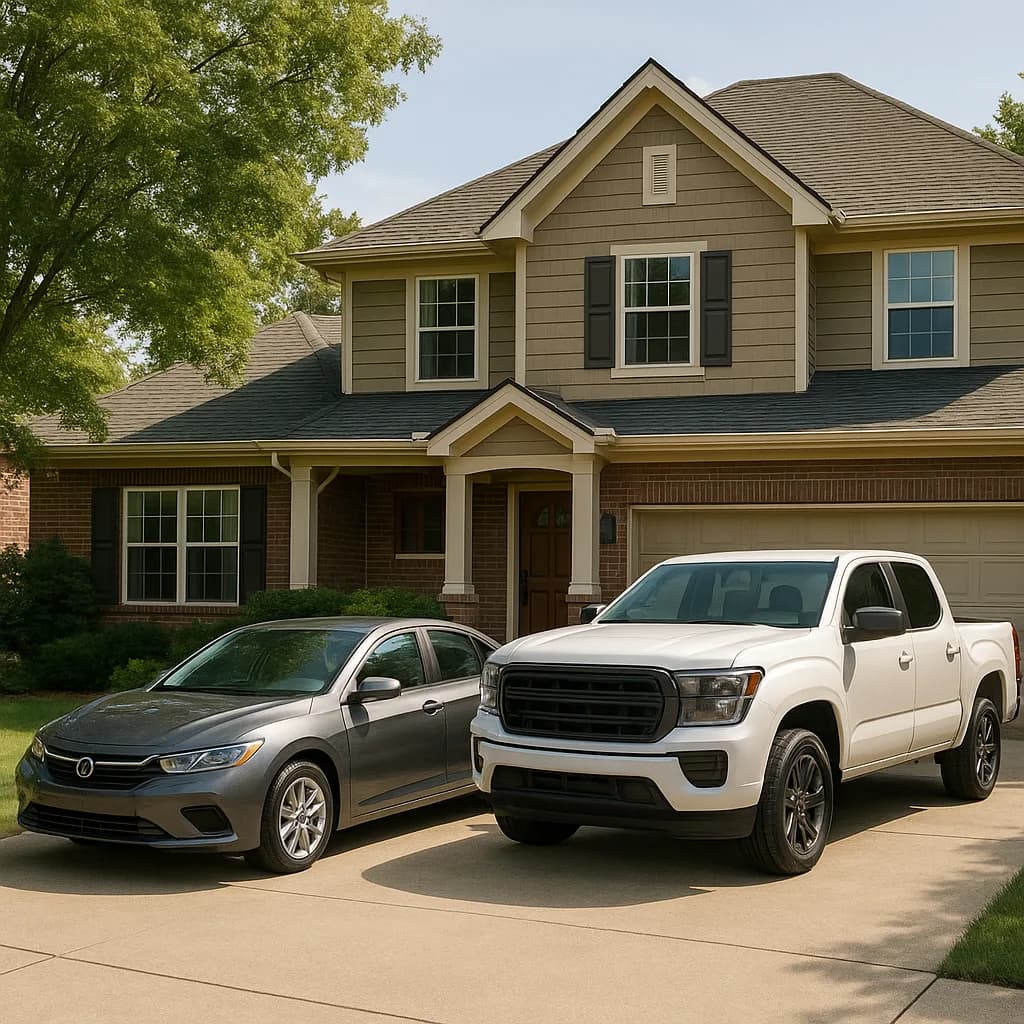
For a multi-vehicle household, this creates a structural fork. When one household member qualifies for USAA membership, that person can open a policy and add vehicles they own or co-own. When a second household member does not qualify — a spouse with no military affiliation whose parent was the veteran, or an adult child whose stepparent served but whose biological parent did not — that person cannot be added as a named insured on the USAA policy. The vehicle they own must either be titled to the qualifying member or insured separately with a different carrier.
This is not a coverage exclusion or a household-size limit. USAA writes multi-car policies. The blocker is membership: the person who owns the vehicle must either qualify for membership themselves or title the vehicle to someone who does. A household managing three cars where only one adult qualifies cannot consolidate all three under USAA unless every vehicle is titled to the qualifying member.
A vehicle titled to a non-qualifying household member cannot be added to a USAA policy, even when another household member qualifies for membership.
How the Multi-Car Discount Works When You Qualify

The multi-car discount requires every vehicle to sit on the same USAA policy. Adding a second vehicle to an existing policy triggers the discount on both cars; adding a third vehicle increases the discount further. The discount applies to the total premium, not to each vehicle individually, and the savings compound as vehicle count rises. USAA does not publish a fixed discount percentage, and the actual reduction varies by state, vehicle type, and coverage selections.
When you add a second or third car to the USAA policy, each must carry these minimums at a floor, and the multi-car discount applies to the combined premium after those requirements are met. The discount does not reduce the per-vehicle liability premium below what a single-car policy would cost for the same coverage — it reduces the household's total outlay compared to insuring each car separately.
Related Articles





What Happens When One Household Member Does Not Qualify
The most common structural friction: one spouse qualifies for USAA membership through their own service or a parent's service, and the other spouse does not. If the non-qualifying spouse owns a vehicle titled in their name alone, that vehicle cannot be added to the USAA policy. The household has three options: retitle the vehicle to the qualifying spouse or add them as a co-owner, insure the non-qualifying spouse's vehicle separately with a different carrier, or choose a different carrier for the entire household that does not require membership.
Retitling works when the vehicle is paid off or the lender permits a title change. When the vehicle is financed, the lender must approve adding or changing the title holder, and some lenders will not permit it mid-loan. Insuring the vehicle separately means the household loses the multi-car discount on that car, and the non-qualifying spouse pays a separate premium with no household consolidation. Choosing a different carrier for all vehicles — Geico, Progressive, State Farm, or another carrier writing in New Jersey — restores the multi-car discount across every car but removes USAA's rates and service model from the comparison.
There is no workaround that adds a non-qualifying member's solely-owned vehicle to a USAA policy. The membership gate is structural, not a coverage rule, and it does not bend for household convenience.
New Jersey Liability Minimums
Personal injury protection and uninsured motorist coverage are also mandatory.
New Jersey Motor Vehicle Commission
Comparing USAA Against the New Jersey Carrier Roster
When USAA is not an option — because no household member qualifies, or because retitling is not feasible — the comparison frame shifts to carriers writing multi-car policies in New Jersey without membership requirements. Geico, Progressive, State Farm, Allstate, Farmers, Liberty Mutual, Nationwide, Travelers, and Mercury General all write in New Jersey and all offer multi-car discounts when every vehicle sits on the same policy. Each applies the discount differently: some reduce the per-vehicle premium by a fixed percentage, others apply a tiered discount that increases with vehicle count, and a few apply the discount only to certain coverage components.
The household's next step is to compare carriers on the same coverage structure — same liability limits, same deductibles, same optional coverages — across every vehicle the household owns. A smaller discount on a lower base rate can produce a lower total premium than a larger discount on a higher base rate, and the only way to know which carrier delivers the lowest combined premium is to quote each one with identical coverage inputs.
Next Step: Compare Carriers That Write Your Household
If you qualify for USAA membership and every vehicle in the household can be titled to the qualifying member, request a USAA quote and compare it against at least two other carriers writing in New Jersey. If you do not qualify, or if retitling is not an option, compare Geico, Progressive, State Farm, and the other carriers on the New Jersey roster using the same coverage structure across every vehicle. The New Jersey car insurance requirements page lists the state's mandatory coverages and the carriers writing policies in the state, and the comparison tool walks through quoting multiple carriers on identical coverage inputs.